> ## Documentation Index
> Fetch the complete documentation index at: https://docs.spire.dev/llms.txt
> Use this file to discover all available pages before exploring further.
# Architecture
> Core components and system design of Pylon's synchronous composability architecture
## System Overview
**Pylon** enables synchronous composability between appchains and their settlement layer through coordinated sequencing. The system makes cross-chain operations appear atomic to developers while handling coordination behind the scenes.
 ## Core Components
### Sync Zones
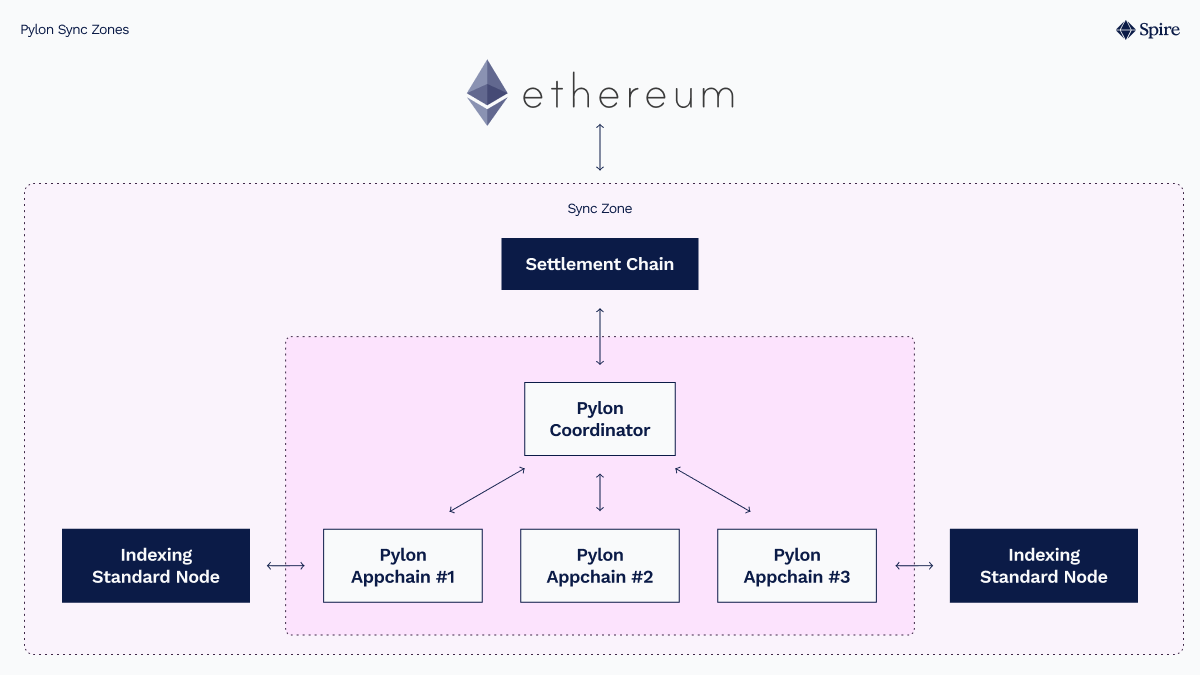
A **sync zone** is a group of appchains that can interact atomically. All chains in a sync zone share the same coordinator and settlement layer.
### Coordinator
The **coordinator** is a Pylon node that:
* Monitors all appchains and settlement layer for cross-chain calls
* Forwards calls to target chains
* Injects results back via priming transactions
* Ensures atomic execution across the sync zone
### Port Contracts
**Port contracts** are smart contracts that store cross-chain call results. They serve as the interface for accessing settlement layer data from appchains.
### Priming Transactions
**Priming transactions** are system transactions that pre-populate Port Contracts with cross-chain call results before user transactions execute.
### Forwarding Proxy Contracts
**Forwarding proxy contracts** provide a developer-friendly abstraction that routes calls to Port Contracts, allowing developers to use standard contract interfaces for cross-chain interactions.
## Transaction Flow
```mermaid theme={null}
sequenceDiagram
actor User
participant App as Application
participant Pylon
participant L2 as Settlement Chain
box rgba(33,66,130,0.25) Appchain
participant Appchain as Appchain
participant Contract as Appchain Contract
participant Port as Port Contract
end
User->>App: Initiate cross-chain call
App->>Pylon: Submit transaction
Pylon-->>App: Transaction received
## Core Components
### Sync Zones
A **sync zone** is a group of appchains that can interact atomically. All chains in a sync zone share the same coordinator and settlement layer.
### Coordinator
The **coordinator** is a Pylon node that:
* Monitors all appchains and settlement layer for cross-chain calls
* Forwards calls to target chains
* Injects results back via priming transactions
* Ensures atomic execution across the sync zone
### Port Contracts
**Port contracts** are smart contracts that store cross-chain call results. They serve as the interface for accessing settlement layer data from appchains.
### Priming Transactions
**Priming transactions** are system transactions that pre-populate Port Contracts with cross-chain call results before user transactions execute.
### Forwarding Proxy Contracts
**Forwarding proxy contracts** provide a developer-friendly abstraction that routes calls to Port Contracts, allowing developers to use standard contract interfaces for cross-chain interactions.
## Transaction Flow
```mermaid theme={null}
sequenceDiagram
actor User
participant App as Application
participant Pylon
participant L2 as Settlement Chain
box rgba(33,66,130,0.25) Appchain
participant Appchain as Appchain
participant Contract as Appchain Contract
participant Port as Port Contract
end
User->>App: Initiate cross-chain call
App->>Pylon: Submit transaction
Pylon-->>App: Transaction received
(tx hash)
par Async Processing
Pylon->>L2: Simulate cross-chain call
L2-->>Pylon: Return result
Pylon->>Pylon: Build superblock
Pylon->>L2: Submit superblock
and Polling
App->>Pylon: Poll transaction status
Pylon-->>App: Transaction pending
App->>Pylon: Poll transaction status
Pylon-->>App: Transaction successful
end
App-->>User: Transaction Confirmation
Note over L2: Execute superblock
Appchain->>L2: Execute
settled block
Appchain->>Port: Execute priming transaction:
Populate Port with cross-chain call result
Appchain->>Contract: Begin executing
user transaction
Contract<<->>Port: cross-chain call
Contract-->>Appchain: Finish executing
user transaction
```
## Key Benefits
* **Atomic execution** - Cross-chain operations succeed or fail together
* **No async handling** - Developers write synchronous code
* **Familiar interfaces** - Use standard contract patterns
* **Real-time data** - Always access current settlement layer state
## Next Steps
* **[Quickstart →](/pylon/quickstart)** - Deploy your first cross-chain contract
* **[Build Onchain →](/pylon/build-onchain)** - Learn to deploy and test applications
* **[Chain Setup →](/pylon/chain-setup)** - Configure your development environment