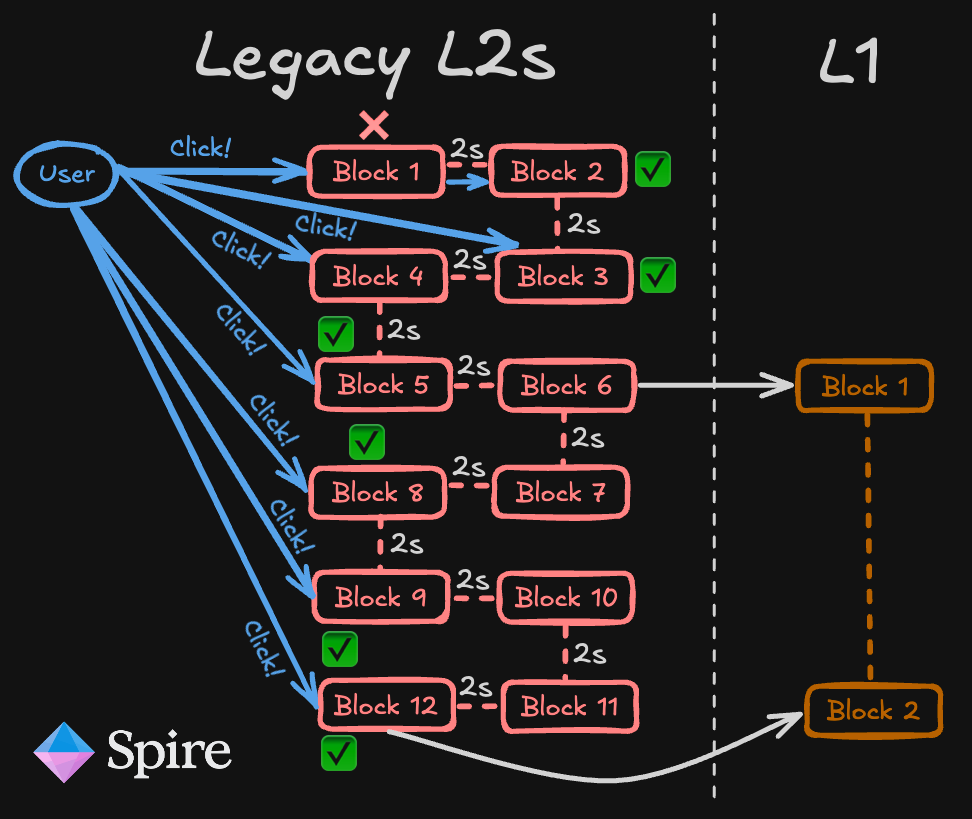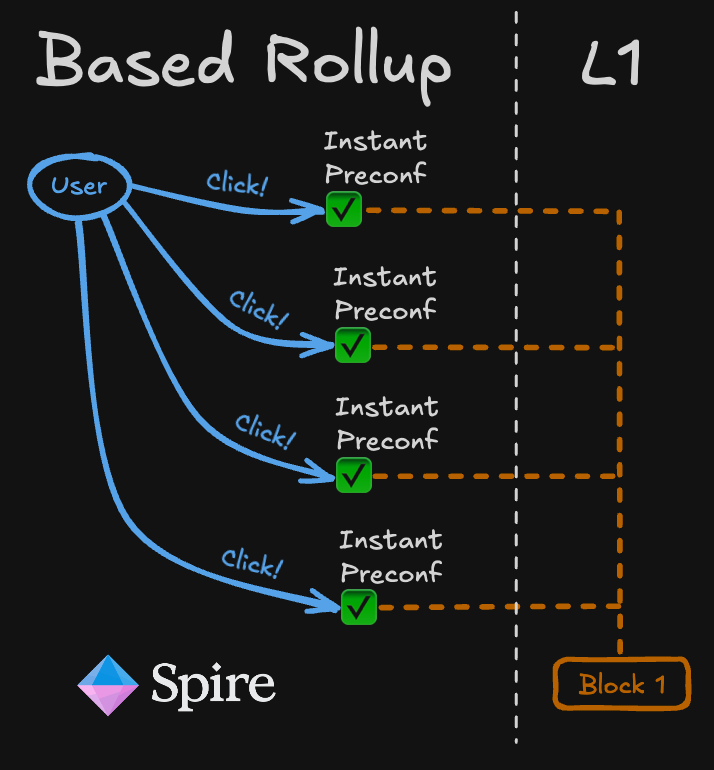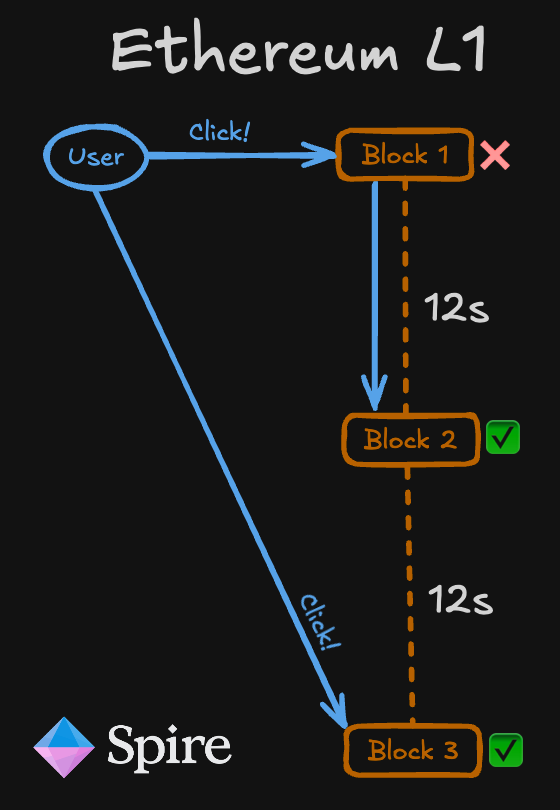
The Ethereum L1 is slow 🐌 Even if slot times were reduced to 2 seconds and single slot finality ↗ existed, it would still not be the best user experience possible. What users want is an instant ✅ when they perform an action. Today, Ethereum has a 12 second block time. The example below shows a user submitting a transaction (e.g. to swap a token) which doesn’t make it into the first block, so they have to wait another 12 seconds before they are included in block 2. Only then can they submit a second transaction. An eternity for users watching a spinner on a website ⏳Documentation Index
Fetch the complete documentation index at: https://docs.spire.dev/llms.txt
Use this file to discover all available pages before exploring further.

More clicks, faster ticks ✅
Non-based rollups (usually with centralized sequencers referenced here as “legacy” L2s) can have much shorter block times than the Ethereum L1. What does that look like for a user? If at time t=0 a user starts with 1 ETH in their wallet on a legacy L2:- t=2s the user buys an NFT on the L2
- t=4s the NFT is used in a game and the player wins 0.1 ETH
- t=6s the user sells the NFT for a profit of 0.2 ETH
- t=8s the user takes a break, it’s been a busy 8 seconds!
- t=10s the user trades their ETH profits for RAI